Played on: Nintendo Switch 2
While I played it well after release, Legends Arceus ended up becoming one of the best Pokemon experiences I’ve had. As someone who largely dropped out of following Pokemon after the generation that introduced me to it (4th gen if you must know), Arceus was a refreshing take on the franchise and had me excited for more. The second entry in the Legends series has fully affirmed for me that the mainline games, barring major changes, have nothing to offer me and that this new spinoff series is the path forward.
I will admit that I forgot essentially everything that had been revealed about the game prior to its release, and originally intended to save it to play later. A chance deal on the Switch 2 edition at the price of the Switch 1 version led to me picking this up shortly after release, and I’m happy that I didn’t put this off.
Verdict
Definitely Play
I give this my highest rating, because I want future Pokemon games to be more like this. The Legends series has offered me the most fun I’ve had since my first game.
SPOILERS MAY APPEAR BELOW
Gameplay
I see three main elements to the game: the Pokedex (duh), mega evolution battling, and the Z-A League. While the latter two are linked by the story, the Pokedex is much more optional, marking a slight change from Arceus and bringing this game closer to the mainline series. I will also touch on side missions here.
Battle Changes & the Z-A League
Let’s focus on the thing most related to the title first: the Z-A League. Essentially trainers are battling every night in dedicated zones to earn points. Earn enough points and you get a ticket for a promotion match. The goal is to reach rank A from rank Z, and I’ll give a slight spoiler that you will not be working your way through all those ranks. To be honest, I’m somewhat disappointed by how much is cut out. I was surprised by my reaction, as the need for so much battling outside of the story was something that brought down my enjoyment of other games. While modern entries have reduced the need to do any sort of grinding, the RPG hater in me still was hating. In this game though, I had a ton of fun with it. Instead of the dynamic turns found in Arceus, Z-A changes to a real-time format. Not only is it real-time, you can position yourself in different ways and moves have a certain range. You don’t have quite fine control over positioning, feeling a little clunky at times as your Pokemon goes between moving with you and moving into range for attack. The switch away from turn-based combat is welcome though, with moves now having a cooldown and windup time based on their power and range.
This all significantly speeds up battles in my experience, especially combined with the ability to sneak up on opponents and get advantage by attacking before being spotted. With the right move, you can eliminate the first Pokemon doing this too. Add in tickets that give little quests to complete, such as knocking out with water type moves 5 times, Z-A League provided a very fun experience. No longer was battling a chore to make sure the team is at a high enough level for the next gym, now it was a way to rack up points and medals. Medals translate into money, and winning more also applies a modifier to give even more money. Between its quick nature and the big number rewards, I found myself looking forward to nighttime rolling around so I could beat up everyone’s Pokemon.
I do have to mention one minor flaw, which is that sometimes sight lines made for awkward battles being triggered where the trainer is above you and the only way to reach them is a staircase that is far enough away that it will count as running away. This is a minor flaw, and honestly the lack of hard battle boundary is really appreciated for immersing you more into the battles.
Mega Evolution
Now the benefits of real-time battling do apply elsewhere, as to catch wild Pokemon, especially the powerful alphas, you will need to fight. There are also many side missions focused on battling. However, we have one more big part of the game, making its return from X & Y is mega evolutions. Now while the games themselves don’t have a good reputation, mega evolutions always seemed to me like the most popular gimmick. Perhaps that is tied to the new designs, or it was interesting for battling, probably a combination of both. I do find it cool, though it really seems like strategy wise it really is just mega evolve as soon as possible.
Most of the mega evolution battling I’m thinking of though is related to the story, which I’ll be touching on further below. Essentially wild Pokemon are mega evolving due to reasons, and to protect Lumiose you must battle them. These fights have multiple phases, and like when fighting alpha Pokemon you as the trainer are also a target. This often means when you do enough damage having to run around dodging some big attack for a few seconds, but for the most part they play like any other battle, just a little harder (and I really do only mean a little, rarely did I feel challenged). I like the battles, though they don’t feel as epic as they probably should. I also dislike that every time the environment changes to a generic circle in a void, rather than being reflective of or taking place on the actual terrain where you find the Pokemon.
The Pokedex
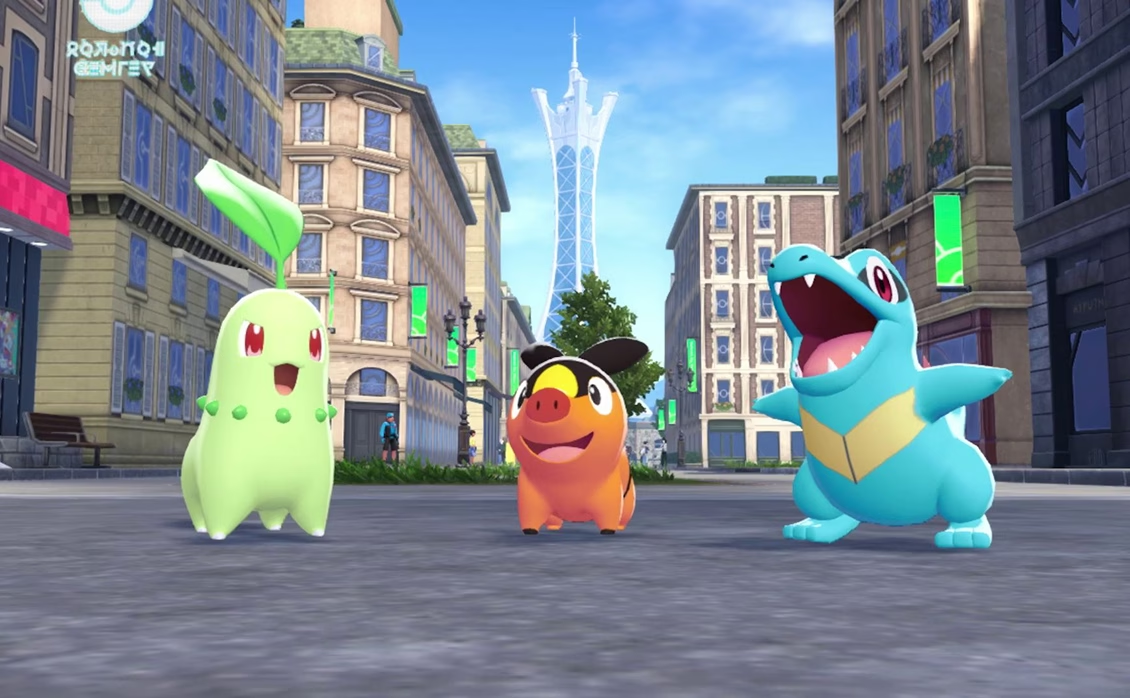
Since battling took the main focus of this game, its a change from Legends Arceus, which was entirely centered around the Pokedex. This makes some sense when we look at the setting for each of these games. Arceus takes place in the largely uninhabited and undeveloped Sinnoh region, still known as Hisui at the time. Learning about the environment and the Pokemon that inhabit are the main mission there so that it can slowly be developed into a place for people. In contrast, Z-A takes place in the present. day in a very developed city, with the Pokemon of the Kalos region being well-documented. However, the game still manages to make the Pokedex make sense, as the story revolves around wild Pokemon coming into the city. Researchers are looking to study which Pokemon previously not found in the city are here now. I just appreciate that so far the Legends games have managed to give a more logical explanation to why the Pokedex is being filled out.
Since the Pokedex is a more optional component of this game it is also made much less tedious than its implementation in Arceus. No longer are there dozens of tasks per Pokemon, instead simply cataloging what appears in each Wild Zone and capturing a certain amount of each type make up the bulk of research missions. The backseat nature of this is emphasized by the related missions being called requests, and outside of a quick introduction none of it has to be done, though outside of catching a number of each type I didn’t really have to go out of my way to complete them either. Overall a really solid implementation of the mechanic this time around.
I do have one problem with the requests, which is a particular series of those requests. While most are directly related to catching Pokemon there is one group focused on battles. Now like I said I actually enjoy the battling in the game. However, the last of these requires 1,000 battles to have been completed. At the end of the game I was at 547, meaning if you do everything the game has to offer you still likely need to do twice as many battles to 100% the game. At time of writing I’m still working on this, and while I already don’t appreciate games wasting my time this one is made extra frustrating by it being a 2,000 point mission when everything else has already gotten me to just 100 points short of completing.
Side Missions
Now side quests in any game can be real hit or miss for me. My completion of them will in part be based on how much I’m enjoying the game overall as well as how easy they are to complete. I did complete the side missions in this game, usually trying to clear them all before progressing the next main mission. They were a nice way to wind down in between along with advancing the Pokedex. I do wish that the missions offered more variety. Many are battle oriented, which in a game already so focused around battling feels unnecessary. These battles often revolve around some sort of specific mechanic or type, so in a way it’s an optional tutorial which is a nice way to implement it. On the other hand since they’re spread out on availability, with some only being in the post-game, it feels a little silly. I would have liked to see more side missions tackle challenges of Pokemon moving into the city, I think that would have been more interesting and expanded the world further.
Story
I don’t really have any knowledge about the story for X & Y, so going into this all I really knew was that there was something 3,000 years ago. I’m sure I knew more during the time the game was being marketed and coming out, but I hadn’t even played gen 5 so I was less in the loop on Pokemon in general. Lysandre being mentioned by name rang some bells, but other than a connection to Pokemon I still knew nothing. The most important details do get covered to some extent, but if like me you have no idea what happened in X & Y, you’re just going to go around a little confused.
As far as returning characters go, I think it’s just AZ, Emma, and Lysandre. Mabel, our Pokemon professor stand-in, may also have been present but it’s less clear and she doesn’t get too much time in the actual story. For that matter, Emma plays basically no role either. I thought as the detective she would be providing some of the key plot details throughout but she only does so once or twice. Lysandre is largely a broken man, having lost his memories, and he’s basically there to tell you what Zygarde is thinking. Now perhaps meant to be a contrast to Lysandre, AZ is presented as a perhaps tragic hero in this story. His creations have caused much trouble, in particular for the city of Lumiose. Through your actions you stop the worst outcome and I guess AZ gets to be remembered well in the end.
The Cast
I’ve focused a lot on the connections to the 6th generation games, but what about the stuff I know to be new. This largely comes down to characters, and I’ll start with the team. Taunie (or Urbain if you chose the female protagonist) is perhaps the deepest, or at least presented as such since she has a whole mystery person she’s searching for which besides helping people is the extent of her personality. The search for that person isn’t brought into focus too much, and its resolution was disappointing and lacking in impact. My own feelings and how the player character reacts in game was a big mismatch, which is not something you want to happen, especially in a RPG title. Other team members are Lida and Naveen. Lida is a dancer, not that it serves much relevance in the main or side plots. Naveen is a somewhat apathetic fashion designer with a Canari (I’ll get to her in a moment) obsession. I don’t feel like we get enough team bonding moments to really make me care or feel like part of a team, so maybe Pokemon should take some notes from the Persona series and deepen this a little. Not full social link implementation, but some of those moments. Maybe look at Persona 5 Strikers and what they did, that was a nice balance.
Outside of the main team we have a whole host of side characters. There’s Jett, the CEO of Quasartico Inc. who plays no real role. Her right-hand man Vinnie gives intel on where rogue mega Pokemon are occurring, which makes up most of the main missions. I’ll give them props for not having the company be the root of all the problems or some twist where the CEO is evil and her secretary doesn’t know. The other big organization that isn’t introduced until maybe halfway through is the Rust Syndicate, led by Corbeau. While initially presented as a sort of gang/mafia you’re in debt to, the developers remembered this is a kids’ game. So when you need to repay your debt to them you end up just doing acts of charity. I am a little annoyed because they basically used this twist of tough guy is actually nice twice between Vinnie and Corbeau, but overall I like Corbeau more between the two and he may be my favorite overall.
We also have Ivor and his sister Gwynn. Ivor is a brute force kind of guy who thinks strength is the solution to everything, while Gwynn is his goth little sister who puts up with his antics. Gwynn is friends with Canari, a popular streamer in Lumiose who is often impersonated in holograms by her grandfather. She’s one of the more likable side characters, though I think if Gwynn got more time I may put her above. Lastly we have Jacinthe, who leads the Society of Battle Connoisseurs and I generally just hated, and her right hand Lebanne, who has the act as a shy maid after being repeatedly defeated by Jacinthe. In the end you do get to team up with basically every character and through the power of friendship win the big battle, but I don’t feel like I really connected enough with the characters to care.
Now I do have two opinions on this. First, I mentioned Persona earlier and I do feel like this game has a decent amount of similarities in what it is trying to do to those games, particularly 3 in terms of story. Like with the team, they could do a little more through either the main story or side missions to deepen the connection. That brings me to my second point which is more of an explanation for my feelings, which is that the lack of voice acting is really starting to kill the series. There are so many cutscene moments in this game that just awkwardly play out with text on screen, mouths moving, and no voices to be heard. I think I would have much stronger opinions on the characters if they had included voices in this game, and with perhaps one of the most involved stories in a game yet this would have been a good time to introduce it.
Overall the story was decent. I feel like I was still missing something in the end having not played X & Y in terms of truly understanding the context of what is going on in this game. I think some characters could have been cut or introduced differently given how little their presence affects things in the game. And again, voice acting needs to be serious consideration for games going forward if they want their story to have more weight.
Graphics & Performance
At least on Switch 2 the game runs well, though I did have a few instances of my TV just going black. This could be any number of things, but given just a week ago I played Donkey Kong Bananza without issue I think it’s tied to the game specifically. Pokemon games, even in their beloved sprite days, have never had the most stunning graphics, and I don’t think any of that changes here. That being said, I do have some specific comments on this.
Apparently the buildings of the city are all one model, as opposed to a model per building or group of buildings. Given some of the running between them you can do perhaps there was a concern on the Switch 1 about load times causing buildings to not appear in time for you to jump between. For the most part building details aren’t modeled, they are just flat textures. This may have been a decision made because the city is a single model, but even not looking for it I quickly picked up on it. I think it’s a shame given that real-life Paris underwent some big changes in the 1800s that influenced many modern city designs, so for a city based on that to take these shortcuts feels like a bit of a disservice.
Conclusion
Through changes to gameplay and a more involved storyline with multiple characters, Pokemon Legends Z-A takes a step up for the series. As someone who has skipped many games and was largely unimpressed with Scarlet and Violet, I found it hard to put this game down. It’s a tough choice to say whether I prefer Legends Arceus or this game, but regardless this second entry proves Game Freak can do more for the Pokemon franchise, they just might need to save it for some non-mainline entries.